Cost cutting is never popular; however, it is often necessary.
At a national level, western Governments are facing unprecedented spending challenges, particularly due to demand for healthcare and pensions, this challenge remains despite an ever increasing ‘tax-take’.
For individual firms the threat of increasing globalisation, automation and increased consumer expectations means the need for achieving and sustaining competitive advantage from cost or differentiation has never been greater.
For citizens poor wage growth, coupled with increasing inflation, puts further pressure on disposable incomes.
The common challenge for Governments, Corporations and Citizens, is to ensure that resources are allocated in an efficient way to achieve objectives, waste is reduced and effective investments are made for the future.
Yet despite the near universal challenge of cost cutting, the evidence of implementation these programmes is pretty poor and shows that most cost cutting programmes fail to achieve their objectives, with most costs creeping back into the organisation within 6–36 months.
The most common tool employed by CEO’s is the notorious requirement for “Across the board cuts”.
Across the board cuts (“everyone needs to cut 10%”) are universally derided, feared, they create uncertainty and anxiety for many colleagues and in many cases are totally ineffective in the long term.
Most organisations know this, yet they still fall into the trap of universal cost reductions, under the banner of fairness.
It doesn’t need to be this way, delivered in the right way, cost saving programmes can result in major improvements in operational effectiveness across both financial, customer and employee measures.
Successful cost control actions feature some (or all) of these characteristics:
It’s in place before its needed
Successful firms run cost control programmes pro-actively to gain momentum, deliver better value to customers and develop a cost advantage — for the public-sector cost reduction enables money to be recycled into other initiatives that directly support the aims of the organisation (e.g. preventative healthcare, capability building programmes)
Understand the efficiency and effectiveness trade-off
Anyone can make 2/5/10% cuts to expenses (SG&A in accounting jargon), the key is to understand the true cost of these cuts and then make intelligent, targeted and sustainable cost reductions. To do this effectively managers need to know, which activities are:
1. Critical to the health of the organisation (“Value Adding”)
2. Expendable as they don’t add value to the customer or the organisation (Non-Value Adding)
3. The organisation currently needs to do these activities, but the customer wouldn’t pay extra for it (Business Value Adding)
Using this information, managers can understand the activities and initiatives which increase efficiency and make considered choices around those that impact on effectiveness.
Understand the relative pain to gain
Cost cutting is hardly ever pain free, therefore it is crucial to understand the relative ‘cost’ of initiatives, whether that is in investment cost, staff morale, effectiveness, customer service or risk of failure.
As initiatives are developed, it is helpful to split opportunities into 3 categories:
- Just Do It’s (JDI’s) / Clear wins
- Worth the trade off
- Last resort
Just Do It’s — initiatives which increase efficiency and effectiveness
Clear wins often come from the need to address a particular problem rather than desire to cut overall costs.
Typically provide a payback in less than 12 months and return 3x their investment cost.
A good example is the use of RPA or automation into business processes, which reduce processing costs and can increase accuracy, compliance and transaction speed.
Other examples including benchmarking across the organisation (e.g. procurement, travel expenditure, support costs, absence, performance markings and spans of control) and externally with comparable organisations.
Worth the trade off — initiatives which increase efficiency but have a negative impact on overall effectiveness or other factors.
Despite the reduction in overall effectiveness they are deemed worth it because of the cost trade off in the short term (long term their absence may destroy value).
Examples include; stopping some L&D activity deemed ineffective, reducing support to senior executives (recognising the trade off’s; in the words of Dave Brailsford “you’ll get more from a £900k rider with a coach than from a £1m rider without a coach”), cutting first class travel and reducing all but non-essential travel. Another opportunity is centralising certain functions such as procurement to take advantage of economies of scale (with the trade-off of loss of local flexibility)
Last resort — plenty of initiatives can reduce costs but will have a damaging effect on certain aspects of performance, in the short and/or long term.
These type of initiatives should only be undertaken during periods of duress, when immediate and deep cost reductions are required
Examples include, delaying payment to suppliers, stopping all L&D activity, cutting product and service quality (increasing wait times by reducing staff levels) – in the short term, however cutting quality leads to higher ‘whole-system’ costs in the long run.
The quality conundrum
One of the first temptations when attempting to cut costs, is to cut quality (e.g. reducing the quality of components used or the number of customer service agents).
This approach is tempting for a number of reasons, especially when looking through a purely financial lens, if the direct material costs can be reduced by 25%, this leads to a visible saving (potentially immediately).
What needs to be considered against these savings are the costs of poor quality (COPQ), these are the range of costs that are incurred (often indirectly) as a result of your reduced quality. If your quality reductions, lead to higher COPQ then the cost-cutting drive has failed and may even mean increased costs in the long run.
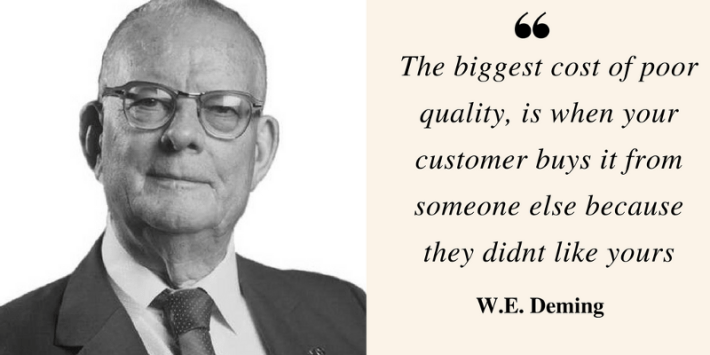
There are lots of different costs resulting from poor quality, some of them are visible some are hidden throughout the organisation.
Examples include:
Visible: rework, recalls, waste, customer rejects, testing, customer returns
Invisible: lost (potential) orders, lost customer loyalty and goodwill, additional management time (firefighting), employee morale, excess inventory (to cover over factors), excess capacity of labour and machines (to cover all of the above)
Counter-intuitively, organisations can often reduce costs by investing in quality, potentially reducing visible and hidden costs and increasing customer value and revenue.
Key to success is understanding the drivers of ‘poor quality costs’ and then making targeted investments/ improvements to increase quality and reduce the costs of poor quality.

Engages the whole organisation
Engaging across the organisation, really involves 4 things:
1. Promoting and enabling the generation and implementation of employee ideas
2. Inclusion of all parts of the organisation — no sacred cows!
3. Exploiting cross-cutting opportunities
4. Understanding the whole organisation as a system
Cost cutting is often something that is often hidden from employees, partly in an attempt to manage morale and industrial relations, but also because of a mis-placed view that employees are unable to positively contribute to effective cost cutting.
To do this effectively you need to align employees around the future vision of the organisation and ensure that the rationale for cost cutting can be explained and defended — this increases legitimacy, acceptance and ultimately the chances of success.
The message should shift from “we need to make 10% cuts” to “Finding ways to cut costs will make us a better organisation, more responsive to our customer needs and providing better value to our citizens”.
Ultimately front line, colleagues are able to spot issues and opportunities, that managers and consultants are not able to see due to their relative lack of proximity to the problem.
From a cost cutting perspective this can be exploited by promoting and organising around employee idea generation and running corporate challenges to focus creativity on one topic.
British Airways ran a cost reduction campaign that focused on one question:
How can we reduce the weight of our aircraft?
This resulted in thousands of new ideas from colleagues all across the organisation; swapping glass wine miniatures with plastic, reducing the number of ice cubes used, reducing the weight of the cabin trolleys and even measures such as descaling the pipes and washing the engines more frequently.
When a plane can save 34,000 litres of fuel per year for each kilogramme saved in weight per seat — the ability of this approach to support effective cost reduction is obvious.
The net result was millions of pounds saved, a workforce that felt valued and part of the future success of the organisation.
Another draw back of the “across the board” cuts approach is that it fosters and reinforces silo working, if each department or team has to achieve 10% a potential response is for managers to focus purely on their area, to get over the notional 10% line. This approach fails to take into account the potential gains from taking cross-cutting view (looking across the whole organisation), there are two main potential gains from doing this:
1. Consistency and sharing best practice (not hording the good ideas in a particular department)
2. Synergies can be identified — areas where collaboration, joint-working and centralisation can provide better outcomes at the same or lower cost
Do it differently, but the same
“I fear not the man who has practiced 10,000 kicks once, but I fear the man who has practiced one kick 10,000 times”
– Bruce Lee
If your department or organisation does a task 10,000 times but has no consistent way of doing it, you are unlikely to learn anything or ever get better.
If your department does a single task, in a consistent way 1,000 times and then learns and reflects on what works and what doesn’t and generates ideas on better ways of doing a standard process and this is repeated 10 times — you will improve, a lot.
Many teams, departments and organisations undertake the same process hundreds of times and sometimes up to millions of times, management is often by “average timings”. Yet far too often, there is no established ‘one best way’ or standardised approach to conducting routine tasks, there is a broad set of instructions with a wide range of flexibility (beyond what the process requires), but this isnt the same nor is it as effective.
“If you think of standardisation as the best you know today, but which is to be improved tomorrow you get somewhere”
-Henry Ford
Significant improvements to productivity, compliance, customer service and cost reductions can be found, by identifying the best way to do a process, showing colleagues how to do it, requiring them to follow it and most importantly empowering them to generate ideas on how to improve how to do it.
In a simulated classroom experiment I was able to improve cycle time of a complex administrative task (replicating a real-world task) by 40%, simply by encouraging participants to document the current “best way” and then iterate this [multiple times] through constant idea generation — many other organisations have done this with real world processes and achieved comparable (or even better) results, this is the foundation of Kaizen.
Time is money

Its a crude overused phrase, but it can be a useful way to understand costs and waste.
Understanding the staff cost per minute is a powerful tool in understanding the micro costs of your processes.
The CI equation helps you apply this to tasks and processes so you can quickly identify the total costs of an activity.
This equation started out as a “cost of meetings calculator” which I created during one long and non value adding teleconference a few years ago, allowing me to calculate the cost of that meeting to the organisation (£479!).

The real power in the tool is the fact that quite quickly you can challenge the value of poor processes and the identify quick improvements.
For example if you have 100 team leaders filling in a form every day (e.g a time sheet or MI return) that takes around 10 minutes, individually 10 minutes may not be worth any improvement effort.
However if you can say the salary of the team leaders is £18k plus the additional “on-costs”; NIC’s, pensions etc. is £7k. You can now calculate the cost per minute (depending on leave policies the number of minutes will be around 70–85k per year). For the purposes of this example let’s use 70k, this means each minute costs around £0.35.
Back to our daily form; 10minutes x 35p. £3.50 (so far not really worth the interest)
Now apply that across the 100 team leaders, it’s £350 (a bit more interesting).
Finally apply that across each working day (200–250), let’s use 200.
The total time cost of the form is now £350 x 200 = £70,000 (a lot more interesting)
Two immediate questions now present themselves:
Does the form/task generate £70k of business or customer value?
If it doesn’t – get rid of it
If it does, then how can you complete the task quicker/ more effectively?
In isolation if you have 100 people doing a process, saving that amount of money isn’t going to touch the sides of any cost reduction effort.
However when you do a systematic review of how time is spent in your organisation, you will find plenty of opportunities for stripping out wasted time. Those team leaders can now be back on the front line coaching and improving performance.
The great thing about this tool is everyone can get involved, it’s scalable (I’ve previously ran “1 million minutes” campaigns) and who doesn’t like been able to stop completing mind-numbing and pointless forms!
Conclusions
Managing and achieving cost reduction is a necessary activity for most organisations, there is no specific formula for success — with plenty of examples of failure.

But recognising the need for cost reduction early, engaging the whole organisation, generating lots of ideas and understanding which initiatives to pursue coupled with strong and consistent leadership will lead to better organisational outcomes and more value being created for customer, colleagues and citizens alike.
**This article incorporates insights from Bain, McKinsey, Deloitte and BCG
 ProductivityLab