The current economic environment is tough — there is the uncertainty of Brexit, increasing trade protectionism and the fact that we are “overdue a recession” these are contributing factors leading more and more firms to defer expenditure and long term investments which results in even more pressure on operating profits for private companies and tax receipts for Government.
One of the key ways to successfully navigate this landscape is to increase productivity — obvious and of course it’s easier said than done.
Productivity means that more can be created for the same, the same can be created for less – meaning that precious scarce resources can be deployed on to other work.
A tool to increase productivity and reduce costs which is often overlooked, but is relatively simple and can be incredibly effective is reviewing the spans of control of your supervisors and re-assessing their supervisory burden.
The first question to ask is:
Why do you have supervisors at all? (Buurtzorg and other organisations are successful with no supervisors).
Assuming you don’t have the appetite to be that radical, then the very good reasons you have team leaders in your organisation is to lead, coach, organise and inspire front line colleagues to deliver products and services to your customers and create value.
How confident are you that your team leaders are doing that 100% of time?
If you are like most organisations, then you are right to not be very confident. In fact, typically supervisors are burdened by other tasks (outside of their control) to such an extent that only between 20–40% of their time is spent in direct value-adding leadership and performance improvement activity – the rest of the time they are ‘burdened’ with other activities.
These wider tasks are introduced into the team leader role, hardly ever through design but through incremental increases in the ask of the team leader (MI returns, checks/ approvals, HR and finance administration) — this crowds out the available time on driving increased performance. Worse still these activities and their time burden are often hidden or believed to be ‘essential’.
Freeing up supervisors to focus on leading and driving increased performance, allows you to make a positive choice out of two options:
- You can increase the span of control — the team leader is able to use their extra capacity to support and lead more colleagues (reducing your need to deploy as many supervisors). Maintaining performance whilst reducing the need for additional supervisors, this can lead to a reduction of your total labour costs by around 5–8%, ultimately boosting productivity.
- You can increase team performance— the supervisor can increase performance by spending more time coaching, identifying improvement opportunities and spending time with customers, which in turn leads to better outcomes at the current input cost – ultimately boosting productivity.
These options are not mutually exclusive it’s possible to do a mix of both.
The challenge and opportunity is to do this sustainably, engaging supervisors and front line colleagues so the net result can be an increase in productivity, whilst maintaining engagement and commitment.
How can this be done?
A quick way to identify opportunities for making improvements in this area is to follow a three step approach:
1 — Review the current structure
This step involves reviewing the activities that supervisors are currently required to undertake across 3 different dimensions (Leader, Manager, Operator) Using the FED model— this is done via supervisor self-assessment, interviews and structured work analysis, the goal here is to understand the true breadth of tasks supervisors are required to complete and how much time on average is spent on each activity.
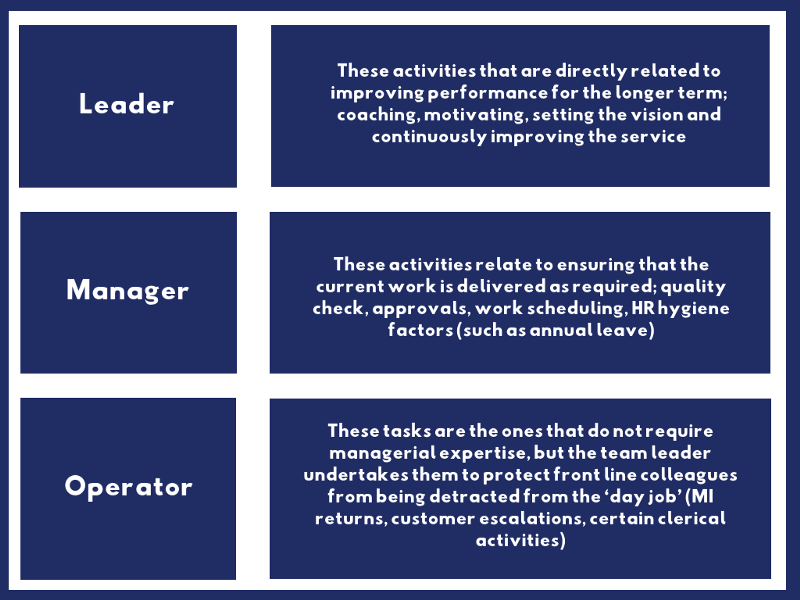
Leader — These activities that are directly related to improving performance for the longer term; coaching, motivating, setting the vision and continuously improving the service
Manager — These activities relate to ensuring that the current work is delivered as required; quality check, approvals, work scheduling, HR hygiene factors (such as annual leave)
Operator — These tasks are the ones that do not require managerial expertise, but the team leader undertakes them to protect front line colleagues from being taken away from the ‘day job’ (MI returns, customer escalations, certain clerical activities etc.)
Typically this reveals about 25–40 different activities that supervisors complete on a weekly basis.
2 — Identify improvement opportunities
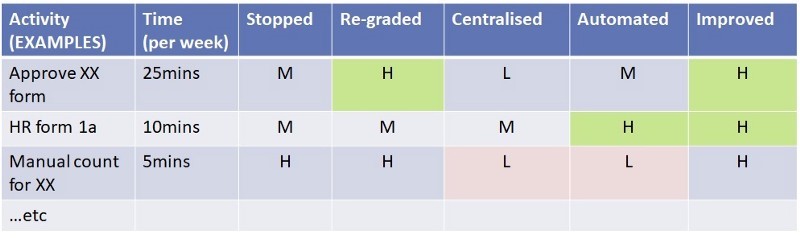
Using the outputs of step one you can now review each activity for improvement opportunities — it makes sense to focus on the most time consuming “Operator” and “Manager” tasks first.
A useful framework, is to look at which activities could be:
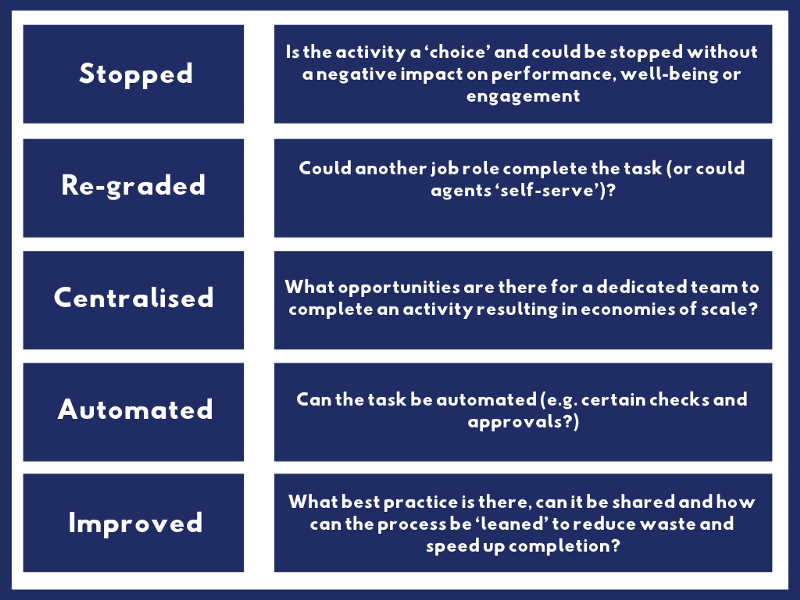
Stopped — Is the activity a ‘choice’ and could be stopped without a negative impact on performance, well-being or engagement
Re-graded — Could another job role complete the task (or could agents ‘self-serve’)?
Centralised — What opportunities are there for a dedicated team to complete an activity resulting in economies of scale?
Automated — Can the task be automated (e.g. certain checks and approvals?)
Improved — What best practice is there, can it be shared and how can the process be ‘leaned’ to reduce waste and speed up completion?
At this stage it is possible to simply ‘t-shirt’ size the opportunities as low, medium or high possibility.
3 — Develop improvement opportunities
Using the identified opportunities, you can now explore the options which can have the biggest impact and you believe has the best chance of success.
Conclusion
What is really good about this approach is that it can identify really quick wins (stopping activity which is no longer necessary), ask some big questions about how you want to organise your teams and it also helps to engage your supervisor community as the organisation is investing in their role allowing them to become better leaders and for their teams to become even more productive. For a modest time investment you can identify quick improvements that will boost productivity.
 ProductivityLab